Armaments cooperation stated aim
“The aim is to achieve cooperation of information, knowledge and technical expertise. This could benefit all the member countries within the field of acquisition and life cycle support. This will be achieved through transparent and mutual exchange of information on planned national procurement in order to identify and exploit possibilities for common development programs, procurement and maintenance of existing and emerging capabilities.”
Political Steering Committee Armaments (PSC ARMA) is in charge of ARMA CS and our activities are reported annually to this level. The PSC level is represented by the National Armaments Director (NAD).
ARMA CS is mandated to initiate, administrate and close down Working Groups in any area that is deemed beneficial for Nordic armaments cooperation. Currently 11 such Working Groups exist. These cover a whole range of cooperation areas, and are comprised of experts from all the Nordic nations’ line organizations, such as Defence Headquarters, Logistics organizations, Defence Ministries, Services, etc.
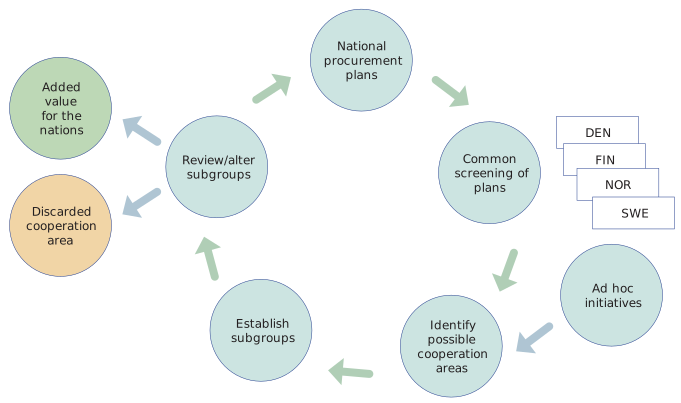
National Screening
ARMA Working Groups & Activities
ARMA CS WG aims to achieve information, knowledge, technical and/or industrial benefits for all the member countries within the field of acquisition and life cycle support. This will be achieved through transparent and mutual exchange of information on planned national procurement in order to identify and exploit possibilities for common development programs, procurement and maintenance of existing and emerging capabilities.
ARMA Working Groups as of April 2026
The ARMA CS Working Group Air Base was formally established in SEP 2025, following Denmark, Finland and Sweden’s identification of air base–related capabilities as an area offering clear potential for Nordic cooperation across the materiel life cycle. Norway will be a contributing member state in the WG from the next meeting taking place in Copenhagen in JAN 2026. The group has been tasked with facilitating information exchange, identifying potential cooperation areas, and supporting capability enhancement and cost efficiency across the Nordic countries.
The ARMA CS Working Group CCD was officially formed as group in October 2025 following Denmark, Norway and Sweden’s identification of CCD as an area with signific potential for Nordic cooperation. The CCD group formalised the scope of work and general operational format. Sweden has been operating as chair for 2025, and Norway will take over at the spring meeting in 2026.
As the CCD area has been somewhat forgotten the last 30-40 years, collective retake of lost knowledge is a priority as well as need for new ideas and solutions to streamline the process. All nations identify the potential and increased capabilities of a joint Nordic camouflage solution for seamless interoperability. The WG is taking steps towards joint procurement of Camouflage materials and will continually invite each other for joint testing and evaluation and over time joint development of new capabilities.
The ARMA CS Working Group CEROS has maintained steady progress during 2025, with a successful WG meeting held in Frederikshavn from 20.–22. OCT. The meeting continued the group’s core focus on cooperation, knowledge sharing, alignment of equipment and functionality, and exploring opportunities for future joint procurement.
A significant development during the year has been the establishment of a new subgroup at the end of 2025. This subgroup will map and compare national Human Machine Interface (HMI) solutions and functional configurations within CEROS fire control systems. An initial follow-up meeting is planned for week 23 in 2026. WG CEROS has also expanded its international participation. Canada and Germany have now joined the WG as observers, reflecting growing international interest in the CEROS domain and the added value of Nordic cooperation.
The ARMA CS Working Group CUAS initiated its work with a Kick-off in Finland in JUN 2025, and since then have formalised the establishment of a WG in SEP 2025 following Denmark, Finland, and Sweden’s joint identification of CUAS as a critical area for cooperation. Norway has not made a decision on participating yet. In DEC 2025 a planning meeting was held in preparation for the coming year.
In its first year, the WG has and will continue to focus on building a shared understanding of national CUAS programmes, including goals, capability gaps and urgent needs related to countering UAS threats. This phase centres on exchanging information on national plans, exploring market developments, mapping possibilities for common procurement and R&D (both multilateral and bilateral) and inviting member nations to participate in national CUAS test and demonstration events. The WG has also begun assessing how to make use of other nations’ terrain and facilities for future test, evaluation and training activities.
The ARMA CS Working Group GEO has continued to strengthen its Nordic cooperation during the past year, with regular in-person meetings and Norway serving as chair. The WG’s work is characterised by ongoing, long-term efforts to improve the production, quality and interoperability of geospatial data across the Nordic nations.
Throughout the period, the group has made steady progress in joint data production, updating key datasets and conducting coordinated quality assurance, both on national materiel and on partner nations’ contributions. Multiple MGCP cells and MGCP 5k datasets were produced or updated, complemented by structured QA/QC both on national outputs and on data delivered by partner nations.
The WG has also advanced a major procurement process supporting future geospatial work, and contributed to the broader Nordic technical coordination efforts, including steps toward a common Nordic infrastructure and the delivery of a 1:2M overview map.
The ARMA CS Working Group ENHAZ continued its structured Nordic cooperation throughout 2025, operating through its established model of smaller WGs and subgroups that meet separately to address specific sustainability and hazardous-material topics. Most meetings are conducted digitally, supplemented by periodic physical meetings, which remain important for collaborative progress.
ENHAZ is organised around two main thematic areas: environmental requirements in procurement and chemicals and hazardous materials, each with its own subgroup. The Procurement area, chaired by Sweden, includes the CSR Subgroup led by Denmark, while the Chemicals area is chaired by Sweden with the Chemical Management System (CMS) Subgroup chaired by Norway. Norway has, in addition, taken over the overall ENHAZ chairmanship from Sweden at the end of 2025.
The ARMA CS Working Group GQA has since its establishment consolidated its work through three underlying Action Teams (AT) focusing on Certification, Documents and Templates, and Training and Education. Together, these ATs support the WG’s overall objective of strengthening Nordic alignment and interoperability in Government Quality Assurance practices, particularly in relation to the application of Allied Quality Assurance Publications (AQAP).
WG METOC Support was formally established in the spring of 2021, with the task of increasing the quality and quantity of METOC products and supporting the armed forces in the Nordic nations by coordinating and sharing data, products, information, and experience, and by co-developing new products.
During the recent years METOC Support have identified an intensifying ambition in all Nordic Armed Forces in the direction of more and deeper cooperation, where the development of the Nordic Air Power Concept and the establishment of a Nordic CAOC act as driving forces for deeper cooperation also for the METOC Support. The annual physical meeting that was held in September 2025 Sweden at the Uppland Wing had the ambition to reflect that and focused on:
- The METOC needs of the Nordic Air Power Concept and a Nordic CAOC.
- The needs for cooperation in METOC education.
- Updates on ongoing developments regarding NWP/OC -models, general limitation products, trafficability, illumination and data redundance.
- Further discussions on common traffic light products.The meeting resulted in over 50 open action points that will be followed up during 2026.
The ARMA CS Working Group NATO CODE has remained active throughout 2025, continuing its ongoing work to strengthen Nordic cooperation within the NATO Codification System (NCS). Since 2023, the WG has met regularly, including four in-person meetings in Stockholm, Helsinki, Oslo and Västerås, with Denmark chairing the group. The WG’s work continues to focus on sharing knowledge and information on codification processes, interpretation of NCS publications, data quality improvements and operational coordination across the Nordic NCBs.
Looking ahead, the WG expects to continue its cooperation on NCS training, harmonised requirements, MDG, digitalisation efforts and improved methods for obtaining materiel data from suppliers, including the forthcoming procurement of DIGIMAT.
The ARMA CS Working Group SPEC has maintained a high level of activity throughout 2025. Throughout the directive period (2023-2025), the group conducted five physical meetings, four digital planning meetings, and organised two Nordic Military Clothing Conferences (NMCC): Stockholm in NOV 2023 and Lahti in SEP 2025.
Across 2025, the WG made progress on several directive tasks. The nations have identified multiple areas where cooperation on soldier protection equipment and clothing may be possible, including 13 technical specifications, information exchange and exploring options for joint procurement. The group has also begun looking into whether national contracts could be used as practical tools for common procurement.
The ARMA CS Working Group UAS has expanded its activities significantly during the last year, conducting multiple meetings and growing to around 40 members. Over this period, the group has matured into a more structured organisation with several specialised sub-working groups, each contributing to a broader Nordic effort to harmonise UAS-related capability development, procurement, training and operational practices. The work has increasingly focused on building common frameworks, reducing duplication, and enabling interoperability across the Nordic countries.
A major development has been the formalisation of commercial and legal cooperation, where dedicated efforts have produced key documents such as the Letter of Intent signed in 2024 and following the Technical- and Implementation Arrangements signed by the Nordic NADs in 2025. This provides a unified commercial basis for future joint activities and procurement processes. In parallel, operational cooperation has advanced through attempts to align training programmes and to work towards mutual recognition or standardisation of educational systems.