Nordic Defence Cooperation (NORDEFCO) is a structure that facilitates cooperation between the Ministries of Defence and the Armed Forces in the Nordic countries. NORDEFCO consists of Denmark, Finland, Iceland, Norway and Sweden.
Established in 2009 with the aim of advancing cooperation between Nordic countries, NORDEFCO has undergone a substantial transformation following the accession of Finland and Sweden to the Alliance. NORDEFCO now serves as a supplement to NATO, contributing to the collective defence of the Alliance by strengthening the deterrence and defence of the Nordic region.
The objectives for defence cooperation between the Nordic countries are stated in the Vision for Nordic Defence Cooperation (2024) and the revised Memorandum of Understanding (2025), both signed by the Minister of Defence of Denmark, the Minister of Defence of Finland, the Minister for Foreign Affairs of Iceland, the Minister of Defence of Norway and the Minister of Defence of Sweden.
The chairship of NORDEFCO rotates annually. Norway is the chair nation of NORDEFCO in 2026.
During the Norwegian chairship, special emphasis has been put on cooperation within the land domain, enablement and total defence.
Structure
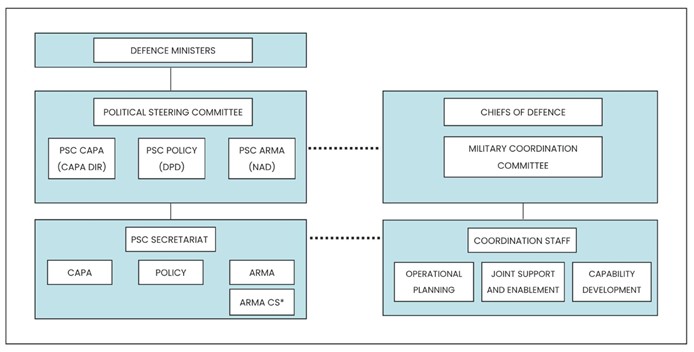
The framework of NORDEFCO enables close cooperation at both the political and military levels between Nordic countries. At the highest political level are the Ministers of Defence. At the highest military level are the Chiefs of Defence.
Between the Ministries of Defence, cooperation takes place through the Political Steering Committee (PSC). The PSC consists of three branches: policy (POL), armaments (ARMA) and capabilities (CAPA). In addition, a PSC secretariat (PSC S) supports the PSC as a preparatory body to the Ministers of Defence.
At the military level, the Military Coordination Staff (MCC), consisting of national representatives of the Nordic Chiefs of Defence, is the counterpart of the PSC. Three Work Strands report to the MCC: Operational Planning (OP), Joint Support & Enablement (JS&E) and Capability Development (CAPDEV). The Coordination Staff (CS) is the executive body of the MCC and is the counterpart of the PSC S.
In order to enable a consolidated cooperation structure within armaments cooperation, an ARMA Coordination Staff (ARMA CS) is under the direction of PSC ARMA, while also supporting the MCC. Read more about ARMA CS.
Courses
The NORDEFCO Peace Support Operations Education and Training programme is a strong example of effective Nordic cooperation.
By dividing responsibility for different types of courses and sharing national instructors, the participating nations have achieved an internationally high standard that would not have been possible individually. Read more
HISTORY AND BACKGROUND
Cooperation is not new to the Nordic countries who, apart from sharing similar history, language and culture, also have a past in the political and military areas. The Nordic Council, formed in the aftermath of the Second World War and the Nordic Passport Union are examples of cooperation in spite of the substantially diverse foreign political circumstances under which the Nordic countries existed during the era of the Cold War.
The Nordic countries have always been strong supporters of the United Nations and have a long tradition of troop contribution to UN operations beginning with the very first UN Emergency Force in Suez/Sinai in 1956, followed by peace support operations side-by-side in Lebanon and the Balkans; notably the combined Nordic units as Nordbat and the Nordic-Polish IFOR brigade.
The contributions gave evidence of the far-reaching cooperation at the military level, regardless of national differences in foreign and security policy. To facilitate the peace support capabilities, responsibilities for training were divided among the nations. Thousands of officers and civilians from around the world have ever since followed the various courses at the Nordic training centres.
From the 1960s, this area was coordinated under the ‘NORDSAMFN’, until 1997 when the ‘Nordic Coordinated Arrangement for Military Peace Support’ (NORDCAPS) was established, continuing the successful coordination of common Nordic efforts in military peace support.
The NORDCAPS Peace Support Operations Education & Training programme was an excellent example of how the Nordic nations can cooperate. By dividing the responsibility for the different types of courses, it was possible to reach international top-level. This had not have been possible if the nations would have attempted to set-up the courses individually.
In the 1990s, closer cooperation on acquisition of materiel was established, based on the principle of mutual exchange of national procurement plans, in order to find opportunities for common development, procurement and maintenance related to defence materiel. During its fifteen years of existence the NORDAC has saved an estimated € 100 million. The work of NORDAC continues within NORDEFCO Cooperation Area Capabilities.
An initiative from the Chiefs of Defence of Finland, Norway and Sweden in 2008 laid the foundation for a wider approach through the NORDSUP, starting with a feasibility study naming more than 140 areas where cooperation either is possible or even necessary to retain defence capabilities. The areas ranged over the entire military spectrum and about a third of the potential areas were assessed to be possible to realize within the following years.
At a ministerial meeting by the end of 2009, it was decided to merge the three parallel cooperation structures into one and a Memorandum of Understanding between the all five Nordic nations on the establishing of NORDEFCO was signed 4 November 2009.